Active Supervision:
Scenario-Based Training for Program Staff
This project involved designing an interactive eLearning module to train frontline staff on the principles of active supervision. The goal was to strengthen staff awareness, improve supervision practices, and reduce safety risks in youth program environments.
The learning experience introduces key supervision strategies and allows learners to practice identifying risks and making safe decisions through interactive scenarios.
Project Overview
Tools Used
This project was designed and developed using:
-
Articulate Storyline 360
-
Google Docs
-
Canva
Frontline staff are responsible for maintaining safe and structured environments for youth. However, inconsistent supervision practices across program sites can lead to safety risks, unclear expectations, and variations in staff performance. Staff may: Lose clear line of sight of youth, remain stationary instead of moving through program areas, miss early warning signs of escalating conflict, or struggle to monitor multiple areas during transitions.
Staff will apply active supervision strategies to maintain safe, organized program environments.
Problem
Learning Gap
Audience
Staff understand expectations but may struggle to apply active supervision strategies in real-time situations.
Frontline staff responsible for supervising youth during daily activities at the Boys & Girls Clubs of San Antonio.
Typical learners include:
-
Youth Development Professionals
-
New hires during onboarding
Learners often work in fast-paced environments and benefit from practical, scenario-based learning that reflects realistic situations and gives them opportunities to practice.
Performance Goals
In simulated youth supervision scenarios, frontline staff will select appropriate responses to common supervision risks according to active supervision guidelines.
Learning Objective (ABCD Method)
Learning Objectives
By the end of this module, learners will be able to:
1. Identify the key components of active supervision.
2. Recognize common supervision risks in youth program environments.
3. Apply active supervision strategies to maintain a safe environment.
4. Select appropriate responses to realistic scenarios based on active supervision guidelines.
Design Approach
This course was designed using a scenario-based learning approach to allow learners to practice applying strategies in realistic situations.
The learning experience combines brief instructional content with interactive elements to reinforce key concepts.
The design focused on:
-
Interactive decision making
-
Realistic workplace scenarios
-
Immediate feedback
-
Practical application
Course Structure
1. Learning Objectives
2. Introduction to Active Supervision
3. Knowledge Check: Multiple Choice
4. Common Supervision Risks
5. Knowledge Check: Drag-and-Drop
6. Scenario-Based Practice
7. Knowledge Check: Scenario-Based Decision Making
8. Key Takeaways
Learning Activities
-
Interactive strategy exploration
-
Risk identification activity
-
Branching supervision scenarios
-
Immediate feedback after decisions
Knowledge is evaluated through:
-
Interactive knowledge checks
-
Scenario-based decision making
-
Completion of all supervision scenarios
Assessment Strategy
Text-Based Storyboard
This storyboard was created during the design phase to plan slide content, audio narration, and learning flow before development in Articulate Storyline.
Branching Decision Paths
Some interactions include branching decision paths that allow learners to explore different responses to supervision challenges.
Depending on their choices, learners receive feedback explaining:
-
Why the decision was effective
-
Potential safety risks
-
Best practices for supervision
Interactive Scenarios
Learners analyze realistic supervision scenarios and determine the best response.
Example scenarios include:
-
Monitoring Multiple Activity Areas
-
Responding to Escalating Conflict
-
Positioning for Clear Visibility
Knowledge Checks
Throughout the module, learners complete short knowledge checks to reinforce understanding.
Examples include:
-
Multiple-choice questions
-
Drag-and-drop matching
-
Scenario-based decision making
Course Features
Interactive Elements
-
Visited-state buttons
-
Conditional triggers
-
Scenario completion variables
-
Decision feedback layers
-
Clear visual hierarchy
-
Consistent navigation
-
Decision feedback layers
-
Logical focus order for screen reader navigation
-
Descriptive alt text for images
-
Closed captioning and transcripts for audio narration
Accessibility Considerations
Reflections
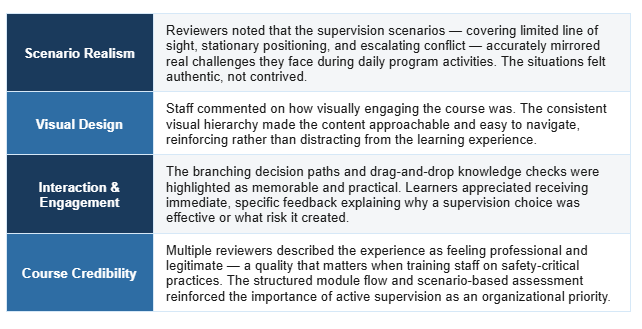
The fully developed Active Supervision module was shared with frontline staff and Youth Development Professionals at the Boys & Girls Clubs of San Antonio for review and pilot evaluation. Feedback from reviewers — including three youth development professionals who confirmed scenario realism and instructional clarity — was consistently positive across multiple sites.
Learner & Stakeholder Feedback
"The examples felt like real situations I face at work. I now know exactly what to do during transitions."— Youth Development Professional,
Boys & Girls Clubs of San Antonio
This project provided a rich opportunity to practice the full instructional design cycle — from analysis through deployment-ready development. Working directly with frontline staff, site supervisors, and program leadership at the Boys & Girls Clubs of San Antonio required balancing multiple stakeholder perspectives while keeping the learner experience at the center of every design decision.
Coordinating SME review cycles, incorporating structured feedback, and validating scenario accuracy against real supervision challenges reported by staff were all skills that grew meaningfully through this project. Managing those review cycles while maintaining a clear and coherent design vision was one of the most valuable professional exercises this project offered.
Professional Growth
Key Skills Developed
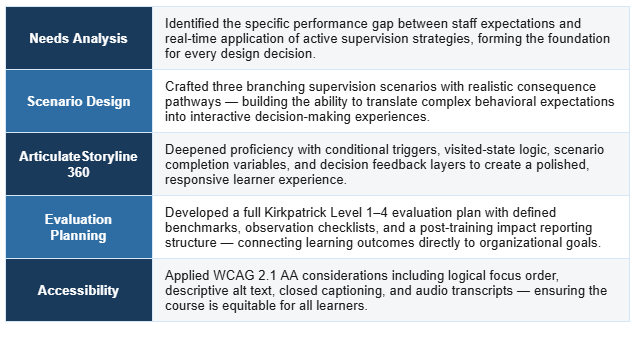
As a learning experience designer, I found one of the most rewarding aspects of this project to be designing the branching paths. Mapping out how each supervision decision — where to stand, when to move, how to respond to early warning signs — led to distinct outcomes required thinking carefully about the cognitive experience of a frontline staff member in the moment. That depth of thinking is what makes scenario-based learning effective, and building it was genuinely exciting.
Creative Reflection
Every custom scene was a chance to put the learner inside a real moment — not just a simulation of a concept, but a window into a situation they have actually faced or will face on the job.
This module is currently awaiting organizational deployment at the Boys & Girls Clubs of San Antonio. A full Kirkpatrick Level 1-4 evaluation plan was designed alongside the course to ensure the training can be measured not just for learner satisfaction, but for real behavioral change and organizational impact. Each level was thoughtfully constructed to generate actionable data for program leadership and HR.
Looking Foward
Method: Review of organizational data before and after training rollout
Data Sources: Incident reports, program site logs, HR performance review data, site director observations
Target Benchmark: 20% reduction in supervision-related incidents within 6 months of full deployment
Reporting: Findings compiled in a post-training impact report shared with program leadership and HR at the 6-month mark
Level 2: Learning
Method: Pre/post quiz comparison using the knowledge checks already embedded in the module
Target Benchmark: Average post-quiz score of 80% or higher, with measurable improvement over pre-quiz baseline
What's Being Measured:
-
Ability to identify the four key components of active supervision
-
Ability to recognize common supervision risks (limited visibility, distractions, unsupervised movement, escalating conflicts)
-
Ability to select the correct supervision strategy in branching scenarios
Kirkpatrick Level 1-4 Evaluation Plan
Level 1: Reaction
Method: Post-course survey administered immediately after module completion
Sample Questions:
-
The scenarios in this course reflected realistic situations I encounter on the job. (1–5 scale)
-
The course was an appropriate length for the content covered. (1–5 scale)
-
I feel more confident applying active supervision strategies after completing this course. (1–5 scale)
-
What was the most useful part of this course?
-
What would you change or improve?
Target Benchmark: 80% of learners rate overall satisfaction at 4 or higher
Level 3: Behavior
Method: Supervisor observation checklist administered 30 and 90 days post-training
Sample Observation Indicators:
-
Staff maintains clear line of sight of all youth in their area
-
Staff actively moves through program spaces rather than remaining stationary
-
Staff identifies and responds to early warning signs of conflict
-
Staff appropriately monitors youth during transitions between activities
Method: Brief self-assessment survey sent to learners at 30 and 90 days
Sample Questions:
-
Since completing this training, how often do you apply the scanning strategy during program time?
-
Describe a situation where you used active supervision strategies from this course.
Target Benchmark: 75% of supervisors observe consistent application of at least 3 of the 4 key supervision behaviors within 90 days
Level 4: Results
Metrics to Track:
-
Reduction in reported safety incidents or near-misses in program areas
-
Reduction in behavioral escalations during program time
-
Increase in staff confidence scores on annual performance reviews related to supervision
-
Decrease in supervision-related corrective actions or policy violations